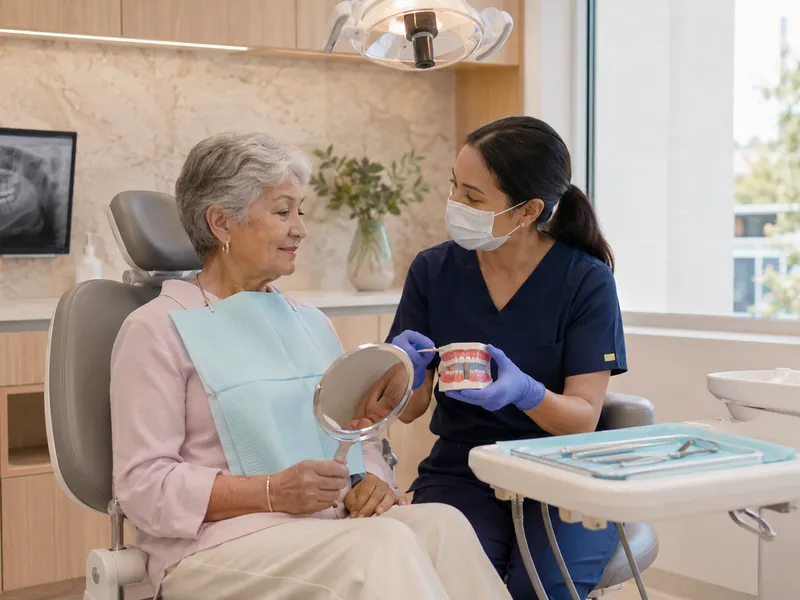
Missing teeth can change the way you eat, speak and feel about smiling. Dentures are one way to replace them, but the word covers several quite different treatments: a full denture replaces every tooth in one jaw, a partial denture fills one or more gaps, and an implant-retained denture connects to implants for added support but can still be removed. This guide uses current information from Healthdirect and the Australian Dental Association's public education site to explain the options and the usual fitting process, so you can have a more useful conversation with a dentist or dental prosthetist. It is general information only, not dental advice: the right way to replace missing teeth depends on your mouth, remaining teeth, gums, bone, health and preferences, and a registered dental practitioner can assess the options that apply to you.
What are dentures?
Dentures are custom-made replacement teeth that can be removed from the mouth. They sit on the gums and may also be supported by remaining teeth or dental implants, and are usually made from acrylic resin, sometimes with a cobalt-chrome metal framework.
Dentures are not the only option for missing teeth. Depending on the gap and the health of nearby structures, a provider may also discuss a fixed bridge, individual implants or a full-arch implant bridge. Each choice has different costs, maintenance needs and effects on the remaining teeth.
Full, partial and implant-retained dentures compared
A full upper denture may gain support from the shape of the palate. A lower denture has less surface area and must work around the tongue, so it can feel different, and a partial denture may use clasps or other components to connect with remaining teeth.
Implant-retained dentures are sometimes confused with All-on-4 treatment. An implant-retained denture is removable, while All-on-4 usually describes a fixed bridge supported by four implants. Ask the provider to show you exactly what will be removed by you, what can only be removed professionally, and what maintenance each option needs.
- Full denture
- What it replacesAll teeth in the upper or lower jaw
- How it is supportedRests on the gums
- Can it be removed?Yes
- Partial denture
- What it replacesOne or more missing teeth
- How it is supportedGums and remaining teeth
- Can it be removed?Yes
- Implant-retained denture
- What it replacesSeveral or all teeth
- How it is supportedGums and dental implants
- Can it be removed?Yes
- Fixed full-arch implant bridge
- What it replacesA complete arch of teeth
- How it is supportedDental implants
- Can it be removed?Not by the patient
| Type | What it replaces | How it is supported | Can it be removed? |
|---|---|---|---|
| Full denture | All teeth in the upper or lower jaw | Rests on the gums | Yes |
| Partial denture | One or more missing teeth | Gums and remaining teeth | Yes |
| Implant-retained denture | Several or all teeth | Gums and dental implants | Yes |
| Fixed full-arch implant bridge | A complete arch of teeth | Dental implants | Not by the patient |
How dentures are made and fitted
The process begins with an examination of the mouth and a discussion about the missing teeth. Existing decay, gum problems or teeth that cannot be retained may need attention first.
Making the denture usually takes several appointments. Records may include impressions or digital scans, measurements of the bite and the position of the jaws, and a trial stage where the tooth position can be checked before the denture is finished.
If teeth are being removed, there may be two timing options: an immediate denture prepared before the extraction and fitted on the same day, or a conventional denture made after the tissues have had time to heal. An immediate denture avoids a period without replacement teeth, but the mouth changes as it heals, so adjustments, a reline or a replacement denture may be needed later. Healthdirect explains that waiting after an extraction can reduce the number of adjustments required, although the timing is an individual decision.
Getting used to new dentures
New dentures can feel bulky or unfamiliar. Speaking may sound different at first, and eating can take practice. Healthdirect notes that adjustment can take a few months for some people.
Sore spots are not something to fix by filing the denture yourself. A dentist or dental prosthetist can identify where it is rubbing and make a controlled adjustment. Arrange a review if there is persistent soreness, an ulcer, bleeding or swelling.
A denture that fitted well when it was made can loosen as the gums and jaw change over time. Adhesive may help in some situations, but it does not correct a poor fit or replace a review.
Cleaning and caring for dentures
Healthdirect's denture guidance recommends removing dentures for cleaning, using a soft brush and mild soap and water because ordinary toothpaste may scratch the surface, and recommends removing them overnight so the mouth can rest.
The cleaning method can vary with the material, attachments and any remaining teeth. Ask the provider what product to use and how the denture should be stored, and remember that natural teeth, gums and the tongue still need daily care.
Regular reviews remain useful even when no natural teeth are left. The provider can check the fit, the condition of the denture and the health of the tissues underneath it.
How long do dentures last?
There is no fixed replacement date. Wear, changes in the mouth, a broken tooth, cracks, staining or loss of fit can all lead to repair, relining or replacement, and a denture may still look acceptable while no longer fitting properly.
Ask at the fitting appointment how follow-up works, which adjustments are included and what future repairs or relines cost. This makes it easier to compare the long-term cost rather than the initial fee alone.
What do dentures cost in Australia?
Published Australian sources suggest roughly $900 to $1,800 for an acrylic partial denture, $1,000 to $3,000 for a full denture for one arch, and $12,000 to $20,000 per arch for an implant-retained overdenture. The Australian Dental Association 2022 fee survey, as reported by CHOICE, put the average fee for a complete upper denture at $1,522, with a range of $1,016 to $2,375.
These are broad, indicative figures, not quotes or national averages. Material, the number of teeth, extractions, appointments, relines and implant surgery can all change the total. If a quote sits well outside them, ask which of those things accounts for the difference. See our dentures cost guide for a fuller breakdown and information about public dental services.
Finding a provider
Dentures may be provided by a dentist or a registered dental prosthetist within their scope of practice. You can check registration through the Ahpra register.
When comparing providers, ask which type and material are proposed and why, how many appointments and trial stages are included, whether extractions, immediate dentures or relines are separate, how post-fitting adjustments are handled, who will provide repairs and future maintenance, and whether alternatives have been discussed.
Find denture clinics near you
Dentist360 lists practices across NSW, Queensland, the ACT and Melbourne, with opening hours, health funds and accessibility compared side by side.
Frequently asked
Healthdirect recommends removing dentures overnight so the mouth has time to rest. Cleaning and storage instructions can vary by material, so follow the advice supplied with your denture.
Many cracks, broken denture teeth and fit problems can be assessed for repair or relining. Do not use household glue or reshape the denture yourself. The damage and the fit need to be checked first.
They are normally removable by the patient. A fixed implant bridge is a different restoration and is removed only by a dental professional when required.
Some state and territory public dental services provide dentures for eligible patients, often with waiting lists and local rules. Check the current eligibility page for your state or territory rather than assuming a concession card guarantees immediate treatment.
Sources
This guide is general information, written from the published sources listed below. It is not a substitute for advice from a registered dental practitioner.
Healthdirect Australia, 2025
DenturesAustralian Dental Association
DenturesAustralian Dental Association
Dental prosthetistHealthdirect Australia
Guide to dental proceduresHealthdirect Australia, 2023
Cost of dental careCHOICE, 2023
How much does the dentist cost? Dental fees comparedCostDoc, 2026
Dentures cost in Australia, patient-reported pricesCostDoc, 2026
Full denture cost in AustraliaCostDoc, 2026
Methodology, how CostDoc collects and publishes price data